Open-source enterprise platform · AGPL-3.0-only

Build the foundation for better enterprise workflows.

DevCraft Platform is an open-source project building a modular foundation for structured data, service management and configurable enterprise applications.

  • Open sourceAGPL-3.0-only
  • Self-hostableOne installation per organisation
  • Metadata-drivenTables, fields, forms and lists as data
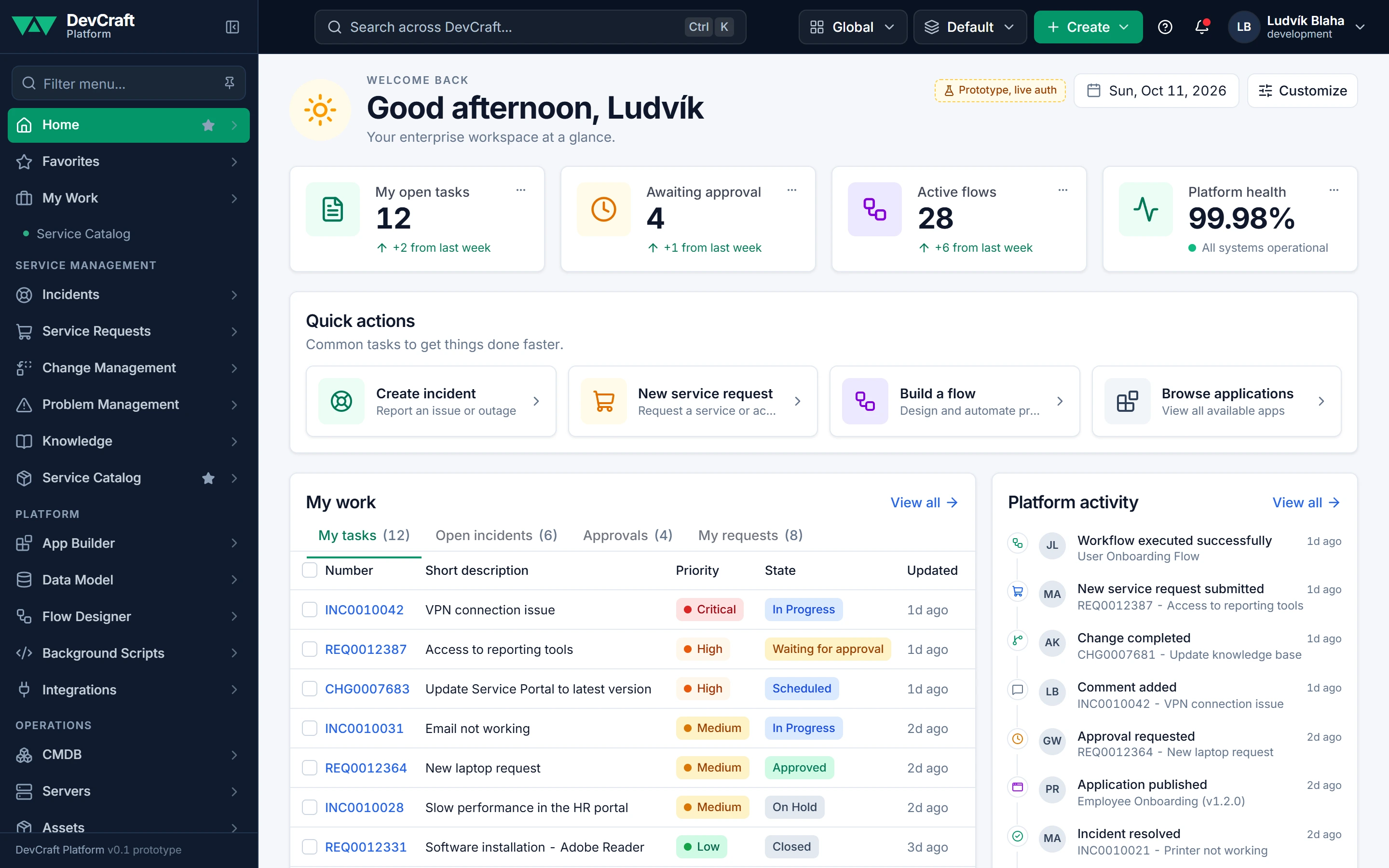
DevCraft Platform workspace: the home dashboard with the dark navigation and the work list Screenshot placeholder
assets/img/dashboard.webp
Development preview with fictional demo data. Dashboard figures are sample values.

The platform

One foundation. Multiple possibilities.

DevCraft is developed as a shared platform foundation for data, applications, access control and service-oriented workflows. Administrators describe tables, fields, references, forms and lists as data, and the platform renders a working application from that data.

Service management, HR cases or asset tracking are meant to be applications built on the platform, not the platform itself. Everything is designed around one read path and one write path for records, so validation, access rules and the audit trail apply the same way wherever data comes from.

  • 01

    Metadata first

    If a feature needs per-table code, the design is wrong. Tables and fields are definitions, not hand-written models.

  • 02

    The server decides

    Everything security-relevant is enforced by the API: access is deny by default, never only hidden in the UI.

  • 03

    One write path, one read path

    Every record read and write goes through the same engine, with validation, numbering and audit in one place.

  • 04

    Foundations before features

    Dictionary, record engine and access control come first; applications follow on top of them.

Core capabilities

What the platform is built from

Each area is marked with its honest status. Implemented In development Planned

Implemented

Metadata-Driven Architecture

A dictionary of tables, fields, choices, forms and lists with a registry of typed fields, table inheritance with overrides and record numbering. Every dictionary change is versioned.

Next: a schema synchronizer that creates physical tables from definitions.
Implemented

Data and Record Management

Generic list and form screens for any table, a filter builder, personalised columns, context and action menus, reference fields, validation, an audit trail of field changes and XML export and import of records with a preview.

Records are currently stored in a generic JSONB record store.

In development

Identity and Access

Authentication, users, groups and roles are in place, with roles resolved through groups and field-level read and write access enforced by the API.

Next: a full access-control engine with record conditions and elevation.

In development

Service Management

A direction for service-related records and request-oriented experiences. Today: task, incident, problem and change tables, a configuration-item class tree and an end-user Service Portal.

The portal's catalogue and knowledge content is illustrative until their tables exist.

Implemented

Configuration Lifecycle

Update sets capture configuration changes. Completed sets are packaged, retrieved from remote instances, compared, their conflicts resolved, and applied in dependency order in one verified transaction.

Back-out and signed packages are still planned. The lifecycle is the focus of the Business edition.

Planned

Extensible Application Platform

Scoped applications that package their tables, forms, rules and flows on top of the shared platform, exported and imported as versioned metadata.

Designed in the roadmap; not implemented yet.

Inside the workspace

A look at the current development build

Screens from the application as it stands today. All people, organisations and records shown are fictional demo data. Click a screenshot to see it in full resolution.

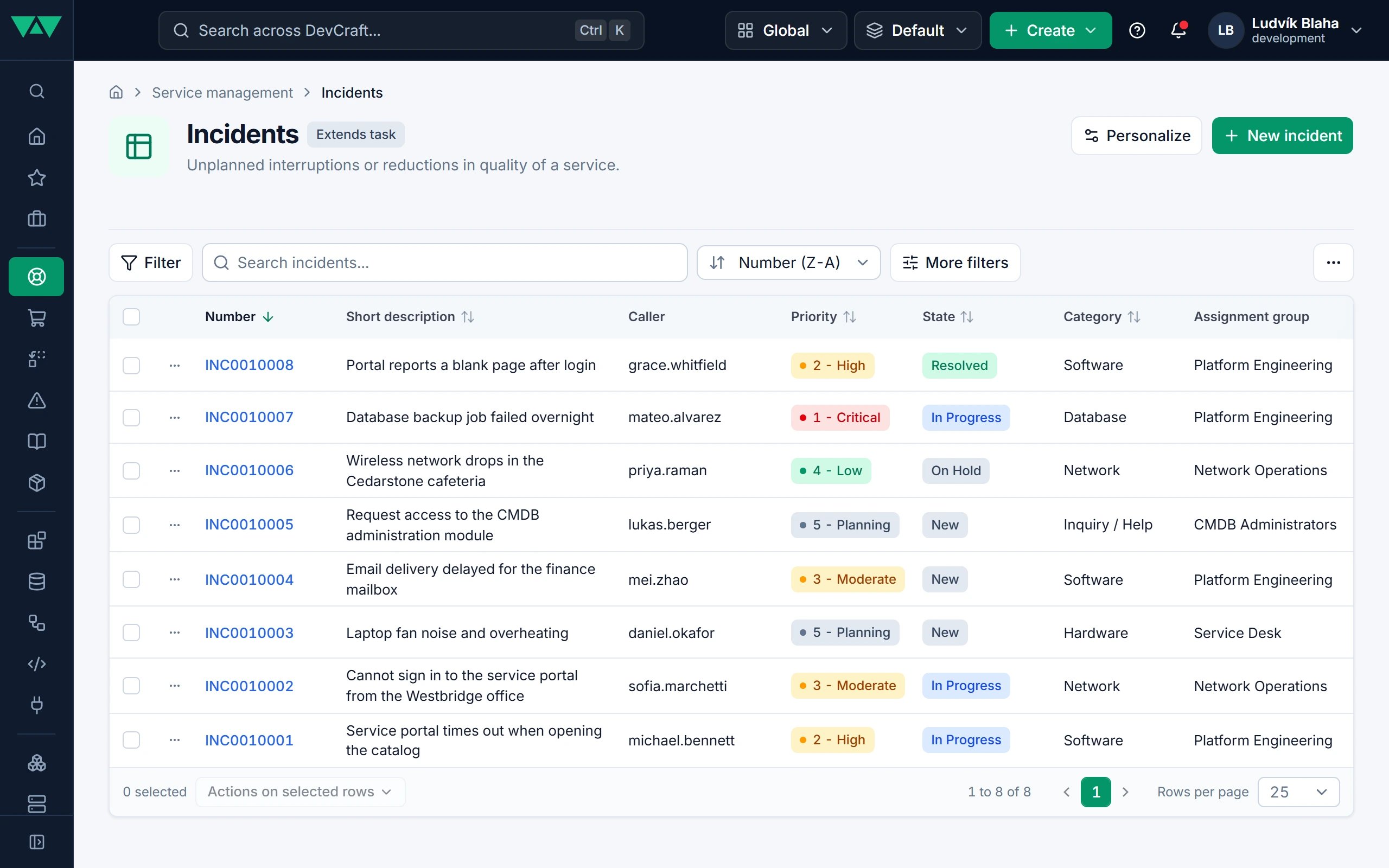
Incidents list: filter, search, sorting, priority and state badges, paging and personalised columns Screenshot placeholder
assets/img/record-list.webp
Implemented

Record lists

One generic list for any table in the dictionary. Filters are stored as an encoded query in the URL, so a filtered view can be bookmarked and shared.

  • Filter builder, search and sorting
  • Personalised columns for every table
  • Paging and XML export
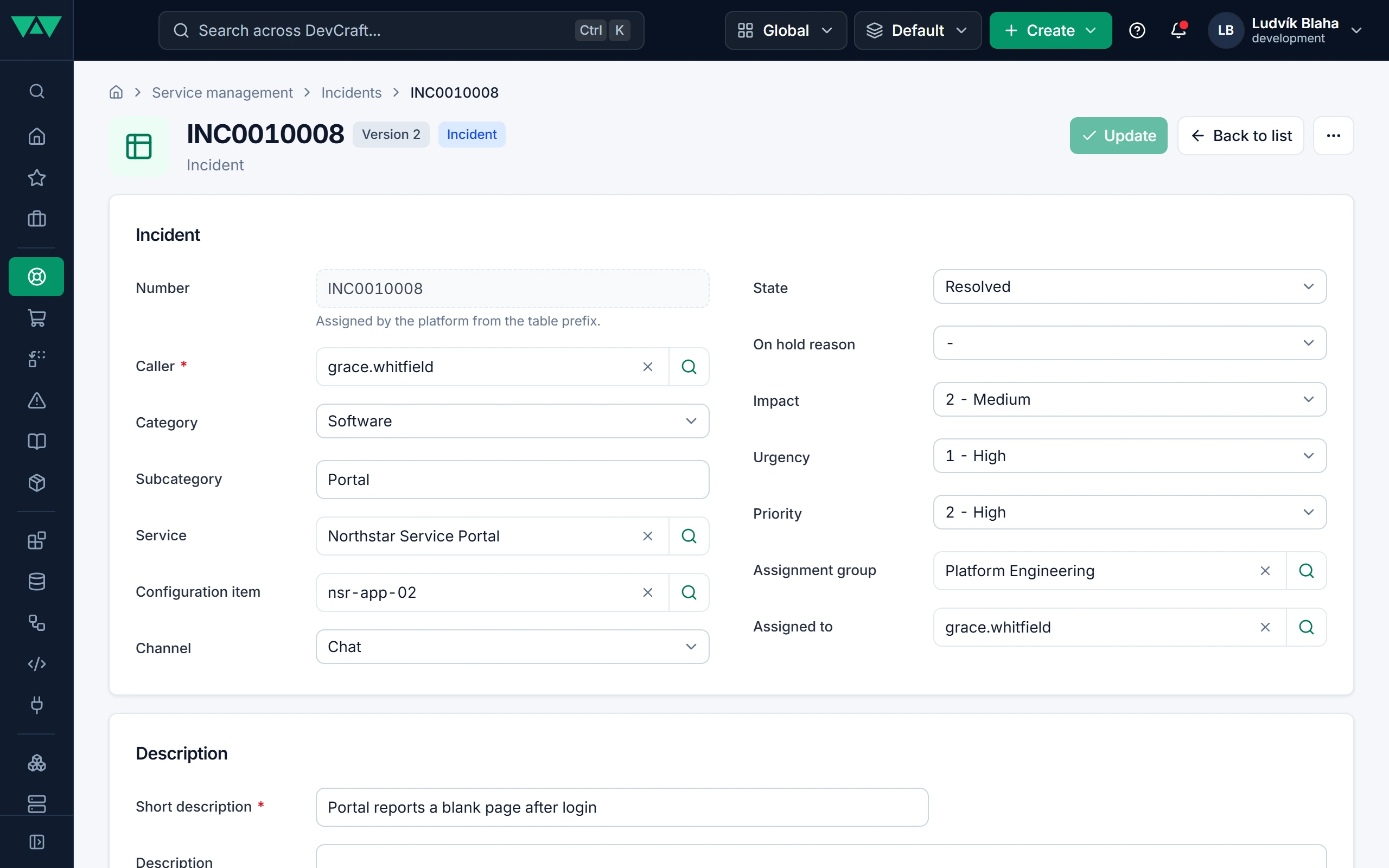
Incident record form with number, caller, category, service, configuration item, state, impact, urgency, priority and assignment fields Screenshot placeholder
assets/img/record-form.webp
Implemented

Record forms

Forms are rendered from the table's metadata, not hand-built per table. The API validates every write and keeps a version and audit trail of the record.

  • Typed fields, choices and references
  • Record numbering from the table prefix
  • Inherited fields from parent tables
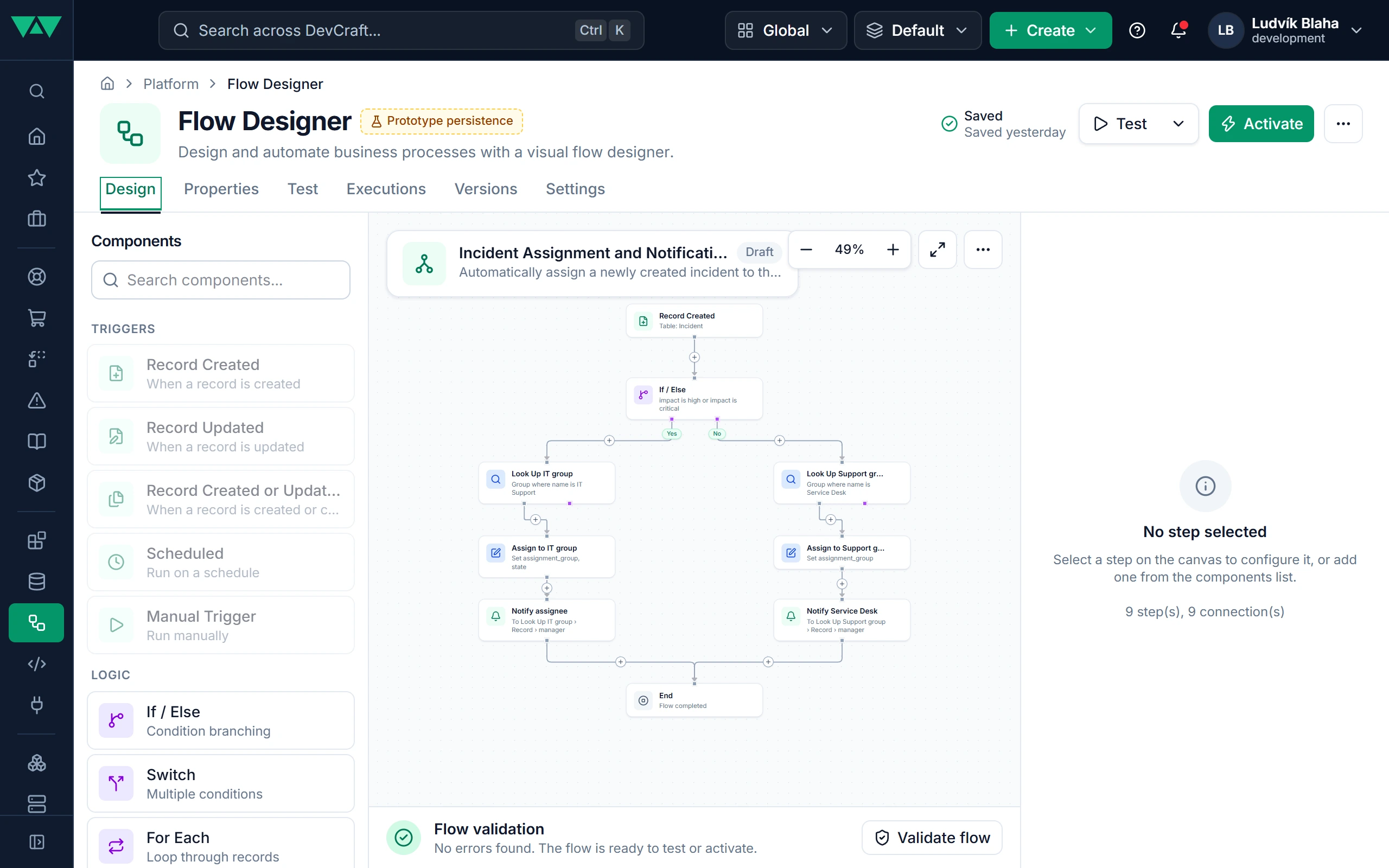
Flow Designer canvas with an example flow: record created trigger, if/else branch, group look-ups, assignments and notifications Screenshot placeholder
assets/img/flow-designer.webp
Editor only

Flow Designer

A visual editor for business processes with triggers, logic, actions and data pills. Flows are saved in the browser for now; the execution engine is planned.

  • Component library with validation
  • Undo, redo, import and export
  • Runtime execution on the roadmap
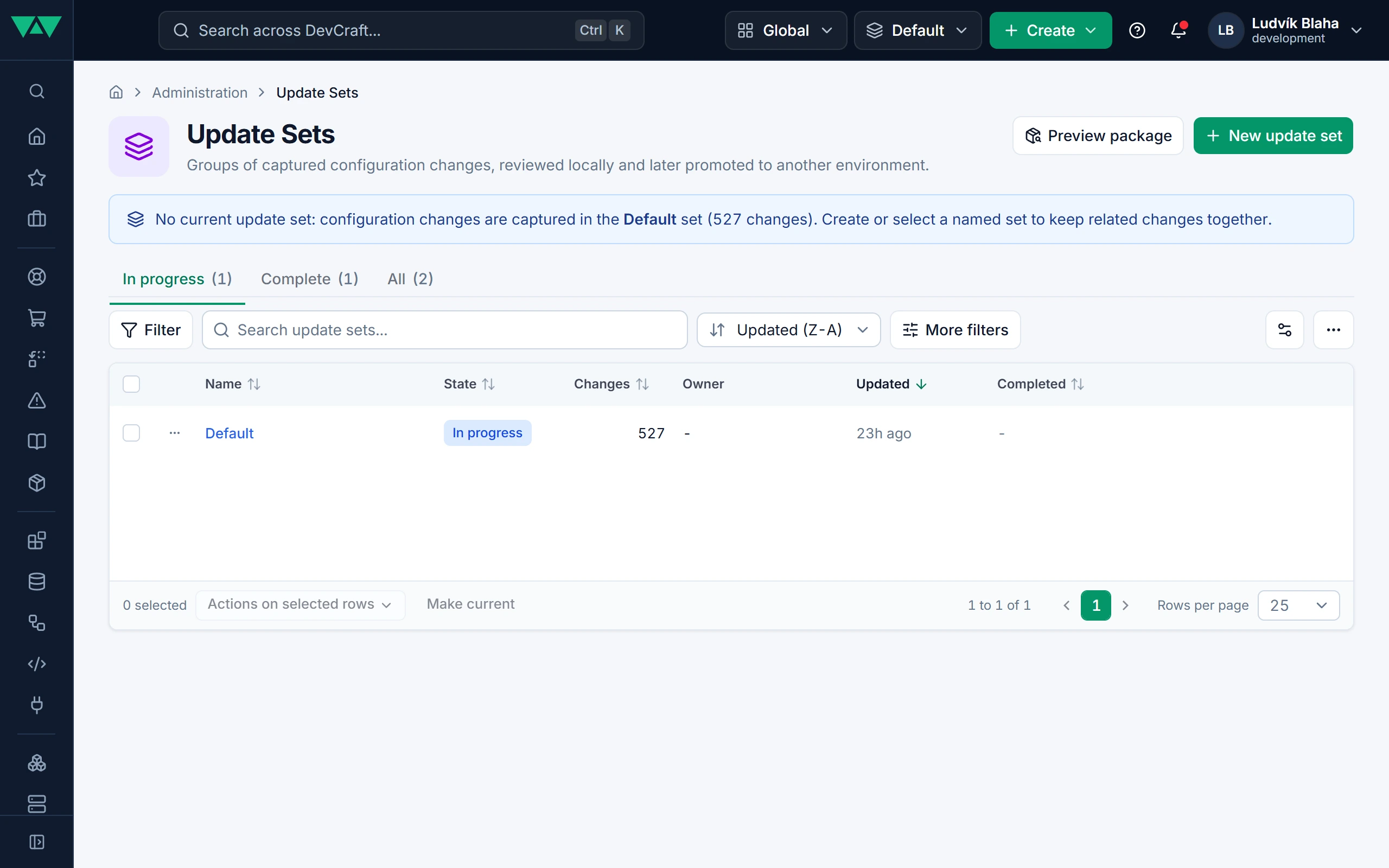
Update Sets page: the Default set capturing 527 configuration changes, with filters, states and a package preview action Screenshot placeholder
assets/img/update-sets.webp
Implemented

Update sets

Every change to tables, fields, forms, lists and configuration records is captured in the update set you are working in. Completed sets become versioned packages that another instance can retrieve, compare and apply.

  • Automatic capture inside every configuration write
  • Versioned XML packages with dependencies
  • Comparison, conflict resolution and verified apply
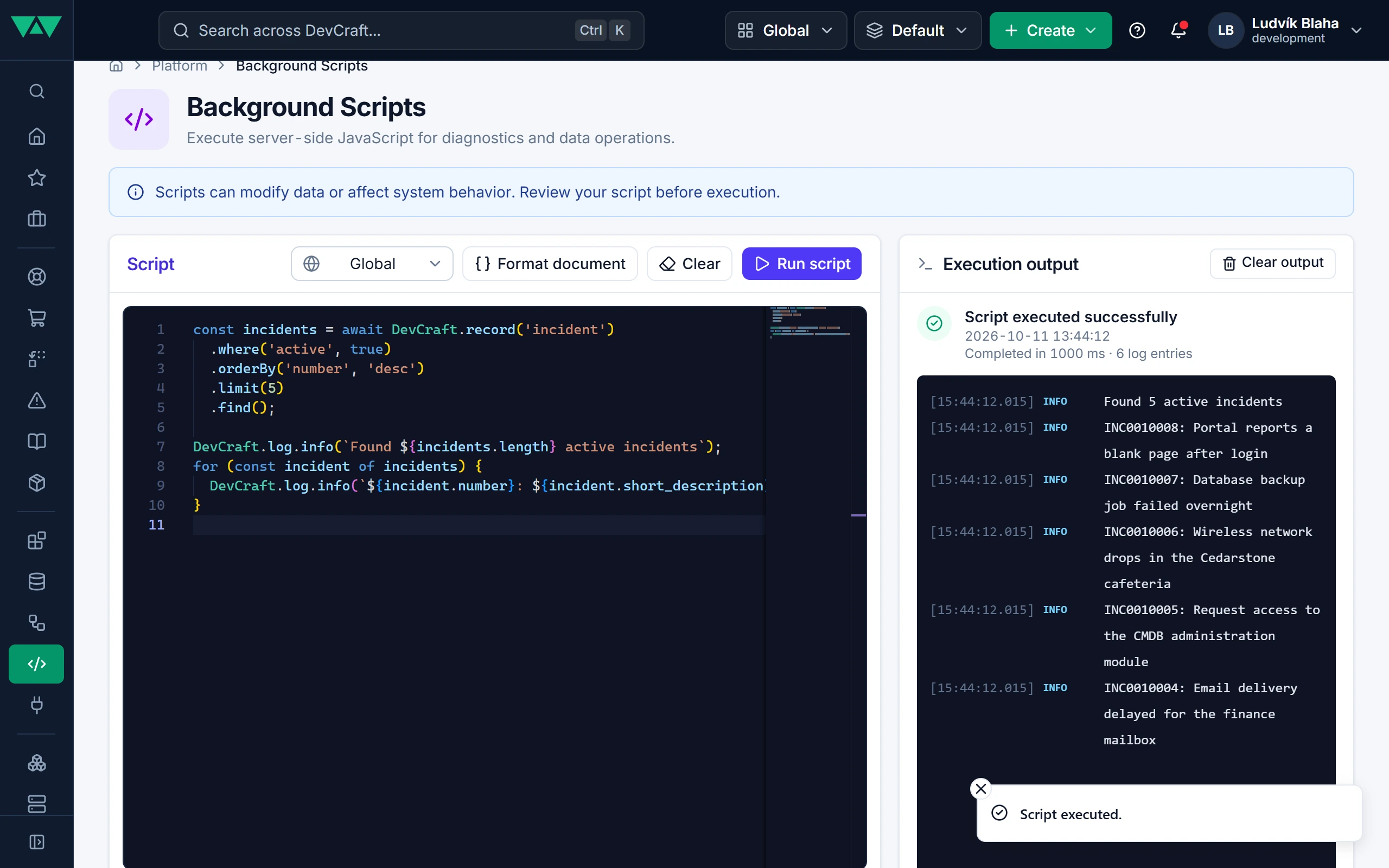
Background Scripts page: a read-only query for active incidents in the code editor and its log output from the runner Screenshot placeholder
assets/img/background-scripts.webp
Implemented

Background Scripts

Administrators run server-side JavaScript for diagnostics and data work. Scripts execute in an isolated runner service and reach data only through the platform API, so access rules, validation and audit still apply.

  • Typed DevCraft script API with editor completion
  • Read-only by default, writes need confirmation
  • Execution history with log output
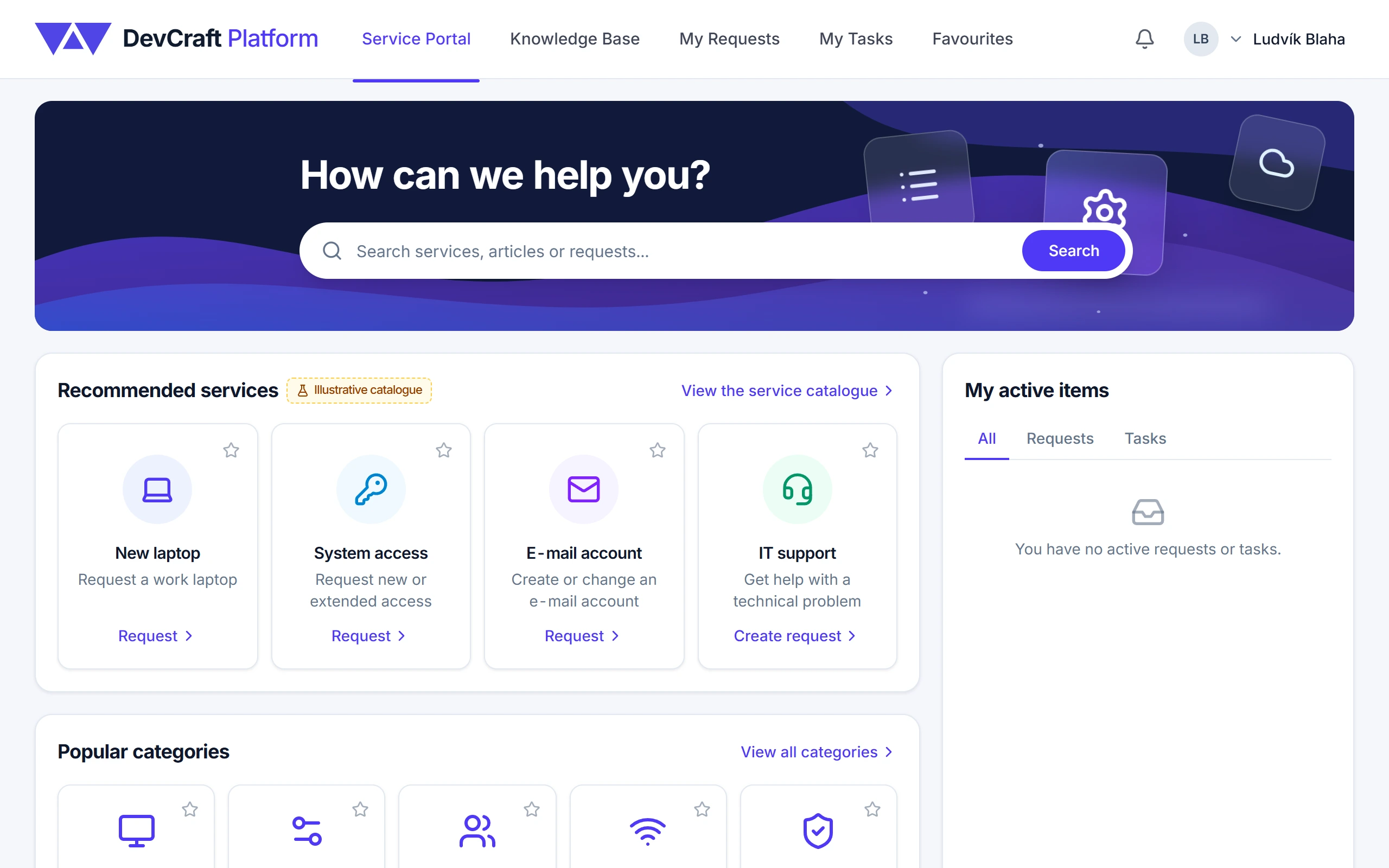
Service Portal home: search, recommended services marked as an illustrative catalogue, and the user's active items Screenshot placeholder
assets/img/portal.webp
In development

Service Portal

A separate end-user surface for requests and help. Active requests and tasks are live data scoped to the signed-in user; the catalogue and knowledge content are illustrative until their tables exist.

  • Own layout for end users
  • Live "my items" from the API
  • Catalogue and knowledge marked as illustrative

How it fits together

A modular monolith with a clear API

A Vue single-page application talks to a versioned Laravel REST API. Platform modules share one metadata and record engine on top of PostgreSQL. No microservices, by design.

The development stack runs in Docker Compose: API, PostgreSQL, Redis, a local mail catcher, the script runner and a scheduler. Read the architecture documentation.

Built for developers

Readable code, documented decisions

The project is developed in the open with its design written down: architecture, data model, security model, roadmap and architecture decision records live next to the code, and the documentation explains how to run the platform and work on it.

  • Explore the source. A Laravel API in modules and a typed Vue frontend.
  • Understand the architecture. Every expensive decision has an ADR.
  • Build on shared concepts. Tables, fields, forms and lists are metadata, not per-table code.
  • Follow the milestones. Each roadmap milestone lists acceptance criteria and tests.
background-script.jsImplemented
// Query records through the DevCraft script API
const incidents = await DevCraft.record('incident')
  .where('active', true)
  .where('priority', '<=', 2)
  .orderBy('number', 'desc')
  .limit(10)
  .find();

DevCraft.log.info(`Found ${incidents.length} incidents`);
Administrators run scripts like this in an isolated runner. Every call is an ordinary API request with the administrator's permissions, so validation, access rules and audit still apply.

Open source

Open by design. Built to evolve.

DevCraft Platform is free software released under the GNU Affero General Public License, version 3 only (AGPL-3.0-only). The canonical terms are in the LICENSE file of the repository.

You may use, study, modify and redistribute it. If you run a modified version as a network service, you must offer its source to the users of that service.

Independent implementation. DevCraft Platform is built from the ground up with its own architecture, technology stack, user interface, visual identity and implementation. It addresses challenges common to enterprise platforms, such as IT service management, configurable data models, access control, audit trails, workflow automation and application development, without reproducing another vendor's product. It does not use copied source code, proprietary assets or confidential materials; public documentation was used only to verify concepts. Read more

Similar purpose. Independent implementation. Open-source foundation.

Configuration lifecycle · Product direction

Move configuration from DEV to PROD with confidence

DevCraft provides the open platform foundation. The Business edition focuses on what comes next: packaging configuration changes and promoting them safely across environments. The workflow below runs in the current development build; each step shows its status.

  1. DEVDevelop
  2. INTIntegrate and test
  3. PRODOperate
  1. 1

    Develop configuration changes

    Changes to tables, fields, forms, lists and configuration records are captured automatically in the update set you are working in.

    Implemented
  2. 2

    Package and review an update set

    A completed update set becomes a versioned package with stable identities, computed dependencies and a deterministic order.

    Implemented
  3. 3

    Compare and resolve conflicts

    The target instance retrieves the set from the source, compares every change with its own configuration and lets you keep local, accept remote, merge or skip.

    Implemented
  4. 4

    Validate dependencies and approvals

    The server checks eligibility and dependencies, and applying requires an explicit confirmation bound to exactly the plan that was shown.

    Implemented
  5. 5

    Promote and keep the audit trail

    Changes are applied in one transaction, verified, rolled back on failure and recorded in a run history with audit entries. Back-out of an applied set is planned.

    Back-out planned

In the development build today: local update sets, versioned update set packages, remote instances with encrypted service credentials, comparison and conflict resolution, and the application engine with run history. Still planned: back-out of an applied set, dictionary deletions and physical table changes through promotion, and signed packages. How promotion works.

Editions and pricing

Open at the core. Professional where it counts.

Community is the complete open-source platform for self-hosting, not a trial. Business and Enterprise are commercial offerings for organisations that need controlled change across environments, services and support.

Community

€0Free forever

For individuals, developers and small organisations that run DevCraft on their own infrastructure.

  • Open-source platform under AGPL-3.0-only
  • Self-hosted on your own infrastructure Docker Compose today; production setup planned for 1.0
  • Metadata engine: tables, typed fields, records, lists and forms Available
  • Authentication, users, groups and roles Available Full access-control engine in development
  • REST API for metadata and records Available
  • Documentation Available
  • Public issue tracking With the public repository
Explore Community

Enterprise

Custom pricing

For large organisations with complex environments, governance requirements and enterprise-scale operations.

Proposed offering By agreement

  • Everything in Business
  • Central management of multiple instances and environments Planned
  • Advanced change approval and governance Planned
  • Custom support agreement and SLA
  • Security and compliance requirements
  • Enterprise integrations and deployment processes
  • Migration, architecture consulting and professional services
Contact Sales

Open source stays open. The Community edition is free software under AGPL-3.0-only. The licence lets anyone use, modify and operate it, including commercially, under its terms. You do not need Business or Enterprise to do that.

What you pay for. Business is a commercial offering built around configuration lifecycle management and the support and services defined in your agreement. Enterprise is a tailored engagement. Items marked Built work in the current development build, which has not reached 1.0; items marked Planned are on the roadmap and not available yet. Prices are annual list prices excluding VAT.

Roadmap and project status

Where the project stands

Taken from the project's roadmap and architecture documents. The roadmap is a working plan without release dates.

Implemented Foundation

  • Vue 3 + TypeScript workspace with navigation, design system and user preferences
  • Laravel REST API with session and token authentication, users and roles
  • Metadata engine: tables, typed fields, choices, forms and lists as data
  • Generic record store with validation, references, audit and configuration versions
  • Table inheritance, record numbering and core platform tables
  • Generic list and form screens, filter builder, personalised columns
  • Roles through groups and field-level access
  • Visual Flow Designer (editor), Background Scripts, end-user Service Portal
  • Update sets: capture, packages, remote instances, comparison, conflict resolution and apply
  • System logging, XML record export and import, list and form context menus
  • Public documentation

In development Current focus

  • Rules engine on record events
  • Groups in authorisation and the access-control engine
  • Schema synchronizer: physical tables from metadata
  • Completing the record engine: locking, delete policies, restore

Planned Later milestones

  • Business rules, notifications and scheduled jobs
  • REST API v1 completion: API tokens, aggregates, OpenAPI
  • Workflow runtime: state machines, approvals, flow execution
  • Back-out of applied update sets and signed packages
  • Scoped applications and metadata-as-code
  • Hardening for 1.0: attachments, search, MFA, SSO, production setup

Help shape an open platform for enterprise applications.

Explore the architecture, follow the roadmap and discover how DevCraft Platform is evolving.

Explore the Source · soon Read the Documentation